


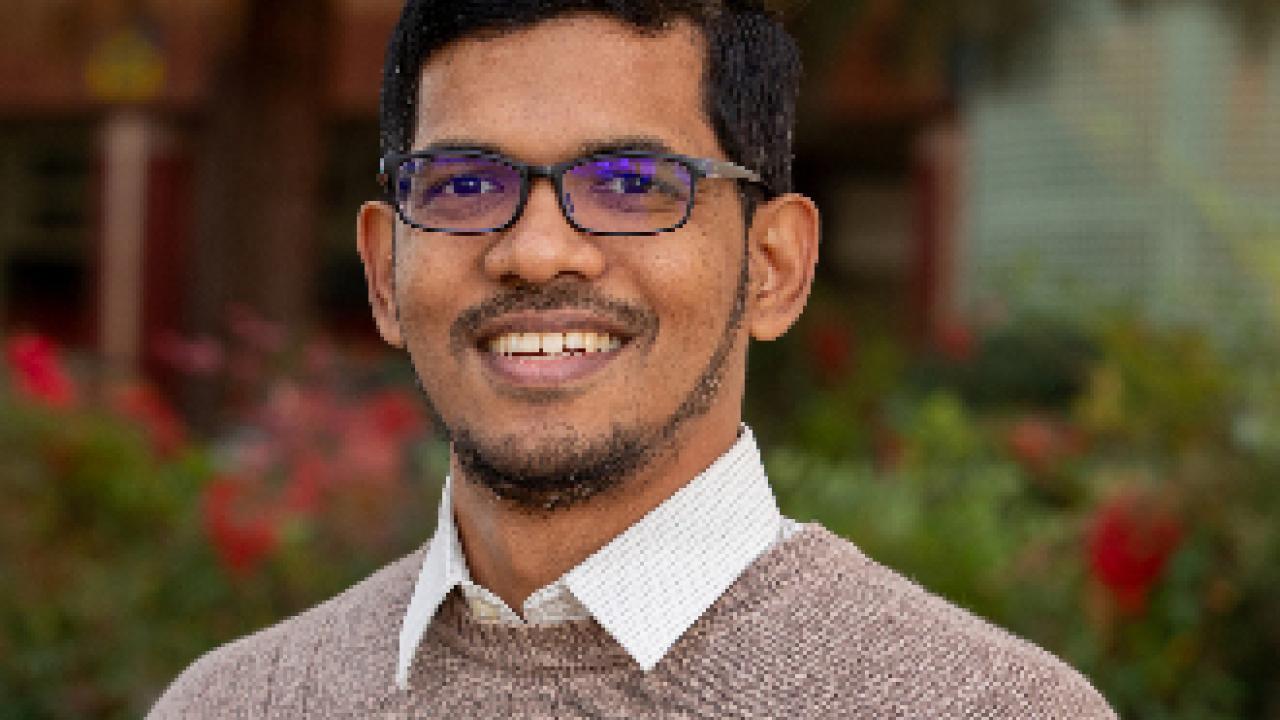
UC Riverside Researcher to Discuss Mosquito Transcriptomics
Karthikeyan Chandrasegaran: How Environmental and Intrinsic Processes Influence Mosquito Phenotypes

Assistant professor Karthikeyan Chandrasegaran of the UC Riverside Department of Entomology will speak on "Network-Based Inferences in Mosquito Transcriptomics" at a seminar hosted by the UC Davis Department of Entomology and Nematology on Wednesday, April 29.
Chandrasegaran will speak at 12:10 p.m. in 122 Briggs and also via Zoom. The Zoom link: https://ucdavis.zoom.us/j/95882849672
"Mosquito behavior results from the interaction of ecological factors, developmental history, and time-dependent gene expression," Chandrasegaran says in his abstract. "Variation in larval environments, especially intraspecific competition, shape adult traits that affect host-seeking, olfactory responses, and ultimately vector capacity, placing these traits within a broader ecological context. In this talk, I link these ecological effects to underlying molecular patterns using network-based analyses of transcriptomic data, revealing coordinated groups of genes associated with behavioral outcomes. Instead of viewing gene expression as static, these methods capture how molecular organization reflects ecological context."
Unified Framework
"A key limitation in transcriptomic analysis is that time-series data are often reduced to independent snapshots, obscuring their temporal dynamics," Chandrasegaran points out. "Extending network-based methods to account for this structure allows us to differentiate gene expression patterns shaped by external light cues from those driven by internal circadian processes. Together, this work develops a unified framework that integrates trait ecology, temporal dynamics, and gene expression to explain how environmental and intrinsic processes influence mosquito phenotypes."
He focuses his research on mosquito ecology, invasion biology, quantitative ecology and life-history variation. His research on "Linking Mosquito Ecology, Traits, Behavior, and Disease Transmission" appeared in Trends in Parasitiology in April 2020.
On his website, Chandrasegaran says "The Chandrasegaran Lab (a.k.a TRiBE Lab), we explore how environmental variation shapes the traits and behaviors of mosquitoes—organisms at the intersection of ecology, evolution, and public health. Our research focuses on how early-life conditions influence individual development, behavioral expression, and population dynamics in ways that affect disease transmission and ecological impact."
"TRiBE stands for Trait-Responsive Insect Behavior & Ecology, capturing our central goal: to understand how trait plasticity enables mosquitoes to adapt to diverse and changing environments. We integrate ecological theory with experimental and computational approaches to uncover the links between environment, phenotype, and performance. By connecting individual trait variation to population-level outcomes, our work helps explain how mosquitoes persist, invade, and transmit disease across ecological contexts. We collaborate with partners in public health and vector control to ensure our findings inform real-world strategies."
The TRiBE Lab "is also a collaborative training environment for students from a range of disciplines. We aim to equip the next generation of scientists with the conceptual and technical tools to tackle complex questions in vector biology and global health."
Educated in India, Chandrasegaran received two degrees from the Shanmugha Arts, Science, Technology and Research Academy, Thanjavur, India: his bachelor's degree in biotechnology in 2009 and his doctorate in evolutionary ecology in 2018. He won a Fulbright-Nehru Doctoral Research Fellowship in 2015 to Illinois State University.
Chandrasegaran served as a postdoctoral research associate at Virginia Tech, from 2018 to 2023. Frontiers in Ecology and Evolution featured his research in its 2019 Highlights. He joined the faculty of UC Riverside in October 2023.
For any Zoom seminar issues, contact seminar coordinator Marshall McMunn at [email protected].