


Student Researchers to Headline Bohart Museum Open House
Event Set Saturday, Nov. 7

Nine UC Davis researchers, primarily graduate students, are scheduled to participate in the Bohart Museum of Entomology's open house on Saturday, Nov. 7.
Their research ranges from native bees and darkling beetles to the diversity and movement patterns of aerial insects.
The open house, free and family friendly, will take place from 1 to 4 p.m. in Room 1124 of the Academic Surge Building. Parking is free.
"The open house coincides with Parent and Family Weekend at UC Davis," said Tabatha Yang, education and outreach coordinator of the Bohart Museum.
Three graduate students will each give a 10-minute talk, followed by a question and answer period. They will speak in an adjacent conference room, Room 1064, of the Academic Surge Building. This is the conference room of the Department of Wildlife, Fish and Conservation Biology.
The schedule:
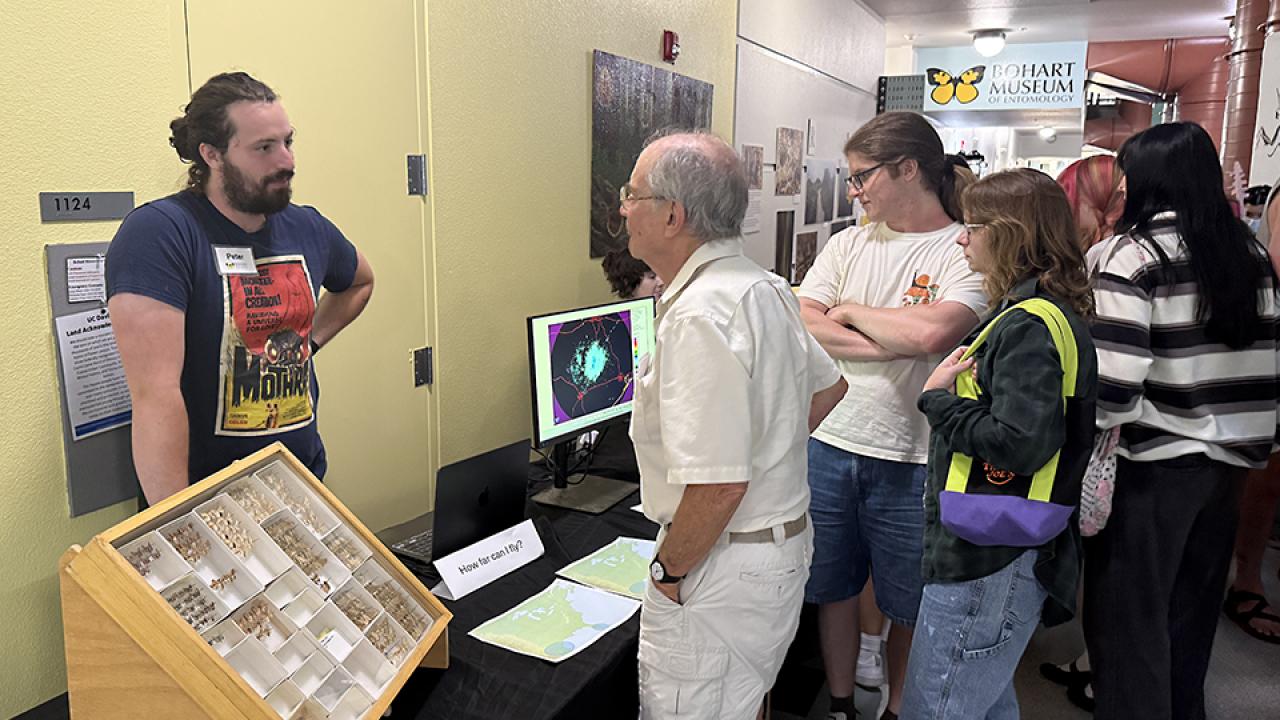
1:30 p.m., Peter Coggan of Population Biology Graduate Group, and a member of the laboratory of Santiago Ramirez, UC Davis Department of Evolution and Ecology, will discuss flying insects, including moth migration. "Countless insects are flying through the sky with little notice," he says. "These insects are numerous potential numbering in the quadrillions. Previous studies have shown these insects are often agricultural pests, disease vectors, and important pollinators. My work focuses on understanding the diversity and movement patterns of aerial insects using both directly sampling them from the sky, and utilizing weather radar networks."
2:15 p.m., Sofía Meléndez Cartagena of the Animal Behavior Graduate Group, and a member of the lab of Professor Stacey Combes, Department of Neurobiology, Physiology and Behavior, will focus on the biological rhythms of native bees in her talk, "The Diurnal Rhythms of Halictus ligatus: What Are Those Busy Bees Even Doing?" Her abstract: "Biological rhythms are almost exclusively studied in laboratory conditions. In my work I'm interested in the field applications of what we have learned about biological rhythms in the lab. Halictus ligatus is one of the many native bees that call Davis home, they are social and nest underground. Because they nest underground they can't use sunlight as a cue to know that it's time to go out and collect pollen before the flowers close. So how do they know when its time to get busy?"
3 p.m., Elsa Hahn of the Animal Behavior Graduate Group, member of the labs of Professor Neal Williams, Department of Entomology and Nematology, and Associate Professor Felicity Muth, Department of Neurobiology, Physiology and Behavior, will discuss her work on the cognition and behavior of oligolectic bees. "Across the animal kingdom, species display vast differences in the environments they experience, the sensory information they perceive, and the cognitive abilities they possess. These differences in cognition are assumed to be driven by differences in the ecological demands species face, yet how ecology drives the evolution of specific cognitive abilities can be difficult to test. Bees are a useful system for exploring this question. Honey bees and bumblebees have demonstrated remarkable learning abilities, from associating floral traits, such as color and scent, with rewards to solving complex puzzles and learning from other bees. However, much of what we know about bee cognition comes from studying these pollen generalists, which collect pollen from a wide range of flowering plants. In contrast, pollen specialists restrict their pollen collection to a narrow range of host plants, despite the presence of other flowers. I am interested in how pollen generalists and specialists use, prioritize, and learn about floral cues while foraging. Through this research, I hope to gain a better understanding of how ecological differences contribute to variation in cognition across species."
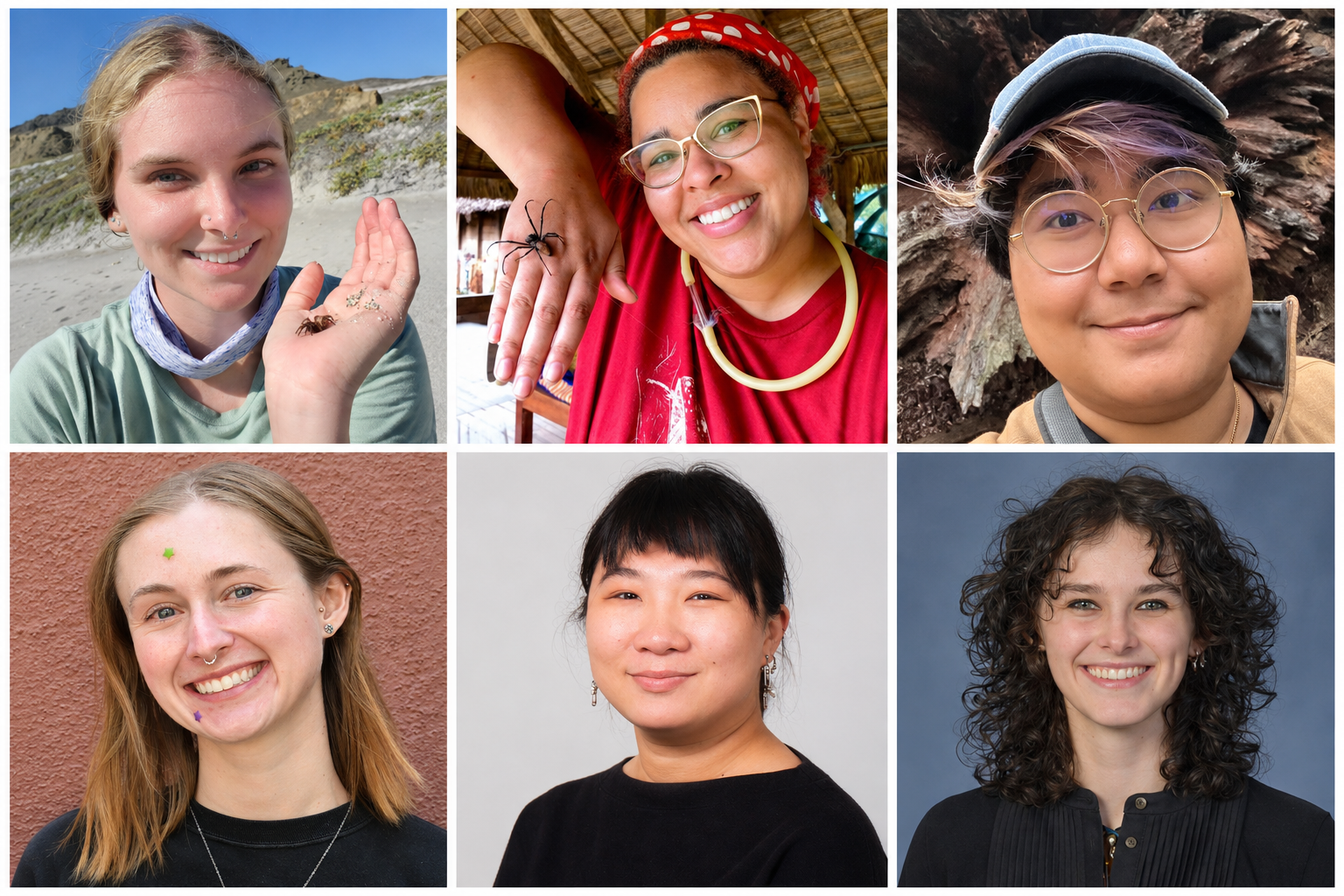
The three speakers also will table at the open house, joining graduate students Iris Quayle, Emma "Em" Jochim, Grace Horne, and Anne Touranachun; fourth-year undergraduate student Bhumi Shrestha; and UC Davis staff member Ray Kennedy, a junior specialist.
Iris Quayle, Entomology Graduate Group, lab of Professor Jason Bond, will discuss her work on the predation effects on coloration of the Namib Desert darkling beetles.
Em Jochim, Entomology Graduate Group, lab of Professor Jason Bond, plans to relate her research on scorpions and trapdoor spiders
Grace Horne, Entomology Graduate Group, lab of Associate Professor Emily Meineke, will discuss her undergrad research with the Caterpillar Lab (New England organization) on looking into secondary effects of the loss of ash trees from the landscape on ash-specialist herbivores. See https://doi.org/10.1093/ee/nvac107
Anne Touranachun of Design, master of fine arts student, "I'll be tabling on my masters thesis concept of 'wordless' signage in science museums and soliciting visitor feedback on some options for the Bohart Museum."
Bhumi Shrestha, Evolution and Ecology, plans to discuss work from the Elizabeth Crone lab on the bumble bee, Bombus crotchii.
Ray Kennedy, lab of Professor Rachel Vannette, says "My project focuses on how native solitary bees from the Sierras interact with an environmental bacterium (Lactobacillus) that has been shown to cause fermentation within bee larval provisions. I ask the key questions: 'What is the bacteria, where is the bacteria, how is it transmitted, do the bees prefer the bacteria, and what might the bacteria be doing?'"
The Bohart Museum, home of a global collection of eight million insects, houses the seventh largest insect museum in North America. Director is Professor Jason Bond, the Evert and Marion Schlinger Endowed Chair of Systematics, UC Davis Department of Entomology and Nematology. He also serves as executive associate director of the College of Agricultural and Environmental Sciences.
The Bohart Museum was founded in 1946 by UC Davis Professor Richard Bohart of the UC Davis Department of Entomology (now the Department of Entomology and Nematology). UC Davis Davis Distinguished Professor (now emerita) Lynn Kimsey served as the director for 32 years until her retirement in February of 2024. She continues to serve as the Bohart Museum Society's newsletter editor.