


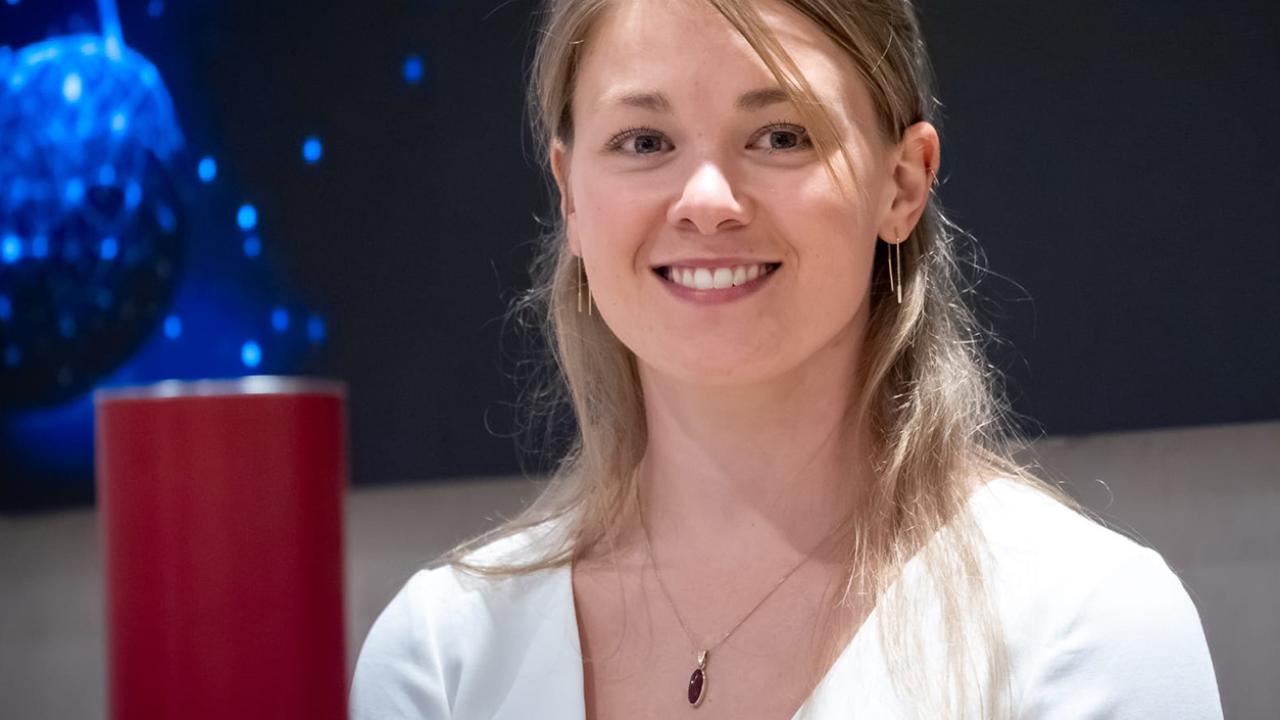
Postdoctoral Fellow Vera Putker Receives Prestigious Rubicon Fellowship
She Joined the Nematology Lab of Shahid Siddique in March 2025

Postdoctoral fellow Vera Putker of the laboratory of nematologist Shahid Siddique, associate professor, UC Davis Department of Entomology and Nematology, is the newly announced recipient of a highly competitive Rubicon Fellowship, administered by the Dutch Research Council (NWO) of The Netherlands.
“This is a prestigious fellowship that recognizes outstanding early-career researchers,” Siddique said.
Putker, who researches molecular plant-nematode interactions, joined the Siddique lab in March of 2025. She is leading an independent NWO Rubicon-funded research project on molecular and cellular mechanisms underlying plant–parasitic nematode feeding site formation, alongside applied research projects on sustainable root-knot nematode resistance in tomato. She also mentors a small team of junior specialists and graduate students.
The Rubicon program allows young research scientists and academicians who recently obtained their PhD to conduct research at a “foreign institute that offers the best environment for their research,” according to its website. NWO is a leading science-funding body which encourages national and international collaboration.
Putker was among 24 researchers selected for the Rubicon Fellowship in the latest round of awardees. The fellowship will cover her research project for 18 months, starting March 1, 2026 and continuing through Aug. 21, 2027.
“In The Netherlands there are three major subsequent research grants called the Veni-Vidi-Vici,” Putker said. “Each of them represents a step forward in the academic career (start tenure track, young group leader, and a senior principle investigator, respectively). The Rubicon is considered the precursor of this path, and comes with more than $215,000 for the research group and to cover my salary.”
Abstract of Her Research Proposal
“Plant-parasitic nematodes (PPNs) are among the most destructive yet least understood plant pathogens, which threat worldwide food security," she wrote in her research proposal abstract. "Every major crop is susceptible to at least one PPN species, causing annual yield losses exceeding $100 billion (U.S. dollars). Unlike other plant pathogens, these microscopic roundworms induce a dramatic reshaping of plant root cells into permanent feeding sites that serve as their sole nutrient source, enabling growth and reproduction.”
“Despite their agronomical impact, we lack a mechanistic understanding of how nematodes reprogram host cells at the structural level, particularly, how the cytoskeletal architecture is reorganized during feeding site formation,” she noted. “My proposal addresses this fundamental knowledge gap in plant-parasitic nematology, using cutting-edge live-cell imaging to capture, for the first time, the dynamic rearrangements of the plant cytoskeleton during infection by the evolutionary distinct cyst nematodes (Heterodera schachtii) and root-knot nematodes (Meloidogyne incognita). I will further dissect how nematode effectors manipulate cytoskeletal components to establish and maintain feeding sites. By tracking feeding site formation in real time, my work will elevate plant-parasitic nematodes to the forefront of host-pathogen biology and provide a conceptual framework to study pathogen-induced long-term cellular reprogramming in living plant tissues.”
Putker holds three degrees from Wageningen University and Research (WUR), The Netherlands: a bachelor’s degree in plant sciences in 2016; a master’s degree in plant pathology and Research Master Cluster in 2019; and a doctorate in nematology in 2025. She conducted her doctoral research on nematode virulence in potato, integrating molecular and cellular approaches with population genomics, studying in the labs of Aska Goverse and Mark Sterken of the WUR Laboratory of Nematology.
Hails from 'The Betuwe'
A native of The Netherlands, Vera hails from the region of “The Betuwe” (city Arnhem). “This is an area famous for its orchards--mainly apples, pears and cherries--so not that different from Davis!" she commented. "At age 14, I took my first job at a farm shop where I developed a keen eye and nose to distinguish different apple, pear and cherry cultivars that were locally grown. This job sparked my lasting interest in agriculture, hence my decision to study plant sciences at the plant sciences at the Wageningen University.”
It was during her master degree studies that she was introduced to plant-parasitic nematodes, “and I have found that nematodes occupy a unique niche in phytopathology due to the intricate and complex relationships they form with their hosts. I am often amazed by how many fundamental questions remain unanswered in our field. This fuels my ambition to continue working on plant-parasitic nematodes, rather than any other pathogen.”
Following her time at UC Davis, she said hopes “to continue in this field for a second postdoc with possibilities to grow into a faculty position.”
NWO owns 10 research institutes where international leading research is conducted. It currently funds more than 7,500 research projects at universities and knowledge institutions. NWO annually invests almost 1.5 billion euros in curiosity-driven research, research related to societal challenges and research infrastructure. The amount equals $1.69 billion in U.S. dollars.