



Nobel Laureates Inspire UC Davis Biochemistry Students
Two Nobel Prize Winners Virtually Visit Walter Leal's Classroom

It’s not often that a Nobel laureate visits a UC Davis undergraduate classroom, but this year, a biochemistry class in Kleiber Hall struck “gold”—twice.
Not one, but two Nobel laureates chronicled their scientific careers and answered questions during their virtual visits to UC Davis Distinguished Professor Walter Leal’s winter quarter class, “Structure and Function of Biomolecules.”
Nobel laureates Charles Rice of Rockefeller University, a UC Davis alumnus, and Randy Schekman of UC Berkeley separately visited Leal's classroom within a three-week period. Each received the Nobel Prize in the category, Physiology or Medicine: Rice in 2020, and Schekman in 2013. In addition to global recognition, the prize includes a gold medal and cash.
The "golden" opportunities stunned the 220 students, who are primarily in pre-health majors. They described the "once-in-a-lifetime" experiences as both "inspirational and motivational."
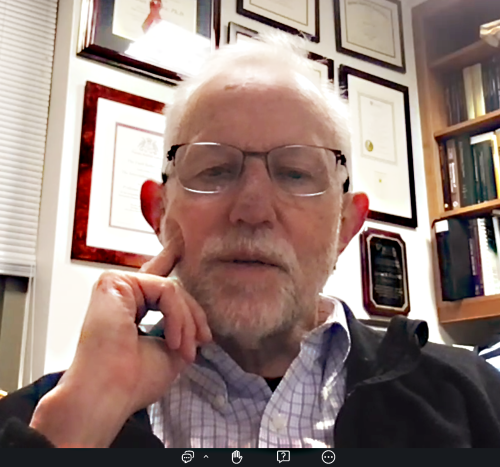
“The Nobel laureate visits provided students with opportunities they never imagined when enrolling in an undergraduate class,” said Leal, who invited his fellow members of the National Academy of Sciences to speak.
“Every winter quarter since I transferred from the entomology department to the Department of Molecular and Cellular Biology, I carry on a tradition inspired by the late entomology professors Charles Judson and Bruce Hammock when I was co-teaching with them. I would invite leading scientists in their field to our classrooms for short interviews with our students. We did that before the Zoom era. Now we can have virtual visits.”
'Unlock Their Imagination and Potential'
Leal, recipient of the 2020 Distinguished Teaching Award from the UC Davis Academic Senate, said of his students: “I seek to unlock their imagination and potential.”
Students filled out an anonymous evaluation form following the virtual visits. “I am extremely grateful for the opportunity to hear from two Nobel Laureates,” wrote one student. “It was truly an honor. I have told many of my family members and friends.”
Other comments:
- “Learning from two Nobel laureates was engaging and meaningful. It is truly inspiring the amount of dedication that Professor Leal puts into this course.”
- "I would have never imagined that I would be ‘face to face’ with 2 Nobel Laureates! As a first-generation (college student), I truly appreciate the opportunity and all of the advice that these two amazing Nobel laureates gave us. I wish to have the same ambition as them to continue in the field of science!”
- "It was an incredible opportunity. Their names pop up in the news, but they don’t seem real until you meet these incredible scientists.”
- "I think it is an amazing opportunity that I wouldn’t have access to anywhere else. Without having these lectures, I wouldn’t be able to listen to two Nobel laureates, and these are the types of opportunities that I will remember and be very grateful for.”

Rice, a virologist who shared the Nobel with colleagues Harvey Alter and Michael Houghton for their contributions to the discovery and characterization of the hepatitis C virus, was born in Sacramento in 1952. After receiving his UC Davis degree, he took a “gap year,” traveling internationally before enrolling in the California Institute of Technology.
'Find What You Love'
In his presentation, Rice encouraged UC Davis students to seek research opportunities on campus as part of their undergraduate experience and to “find what you love and do whatever you can to make your dreams into a reality.”
“I enjoyed Dr. Charles Rice’s visit,” a student wrote. “He was very funny and humble and knowing that someone had little direction but became a Nobel laureate makes me more confident in my abilities to make a change.”
Wrote other students:
- “Dr. Charles Rice’s visit was very helpful to me having heard he took multiple months off to enjoy the opportunities he had outside of science to travel and explore. As scientists we are easily consumed by our work, and it was refreshing to see someone who has balanced both so well.”
- "This really changes our perspective on what we can do in this life as they were once students sitting in the same spot as us.”
- "One thing he said that I will not forget is that we must make time to enjoy life and then we will have the rest of our life to dedicate it to our work. This was great advice because many times we think we need to have everything figured out but undergraduate students have the best opportunity to find what we want to achieve.”
Many of the students later attended the Chancellor’s Colloquium, at which Chancellor Gary May addressed the topic that “scientific progress is best achieved through publicly funded research initiatives.”

Doctorate from Stanford
Cell biologist Randy Schekman, born in 1948 in St. Paul, MInn., but who moved to southern California in the late 1950s, received his doctorate in biochemistry from Stanford University. He shared the Nobel Prize with James Rothman and Thomas Rothman Sudhof for their groundbreaking research on cell membrane vesicle trafficking. They discovered the genetic and molecular machinery that regulates vesicle transport—the “shipping system” of cells.
In his virtual visit, Schekman commented on how science and politics are intertwined, and why government research funding is crucial.
“Dr. Randy Schekman’s visit definitely spoke to me deeply as a student interested in science and politics,” wrote one student. "The two fields are so deeply intertwined at this point in history that you cannot care about one and not the other.”
Other comments:
- “I really liked how Dr. Randy Schekman discussed funding for research and how we should all collaboratively work together to make this a mainstream issue. Seeing his perspective on it makes the problem more important since it is coming from a direct source.”
- "Being able to ask Dr. Schekman a question was not something I thought I would have the opportunity to do, so I am extremely grateful.”
"Overall," Leal said, “hearing about the Nobel laureates’ struggles, failures, and persistence reassured students about their own challenges. These were highly valuable educational experiences, deeply inspirational and motivating, and events they will remember forever.”
