


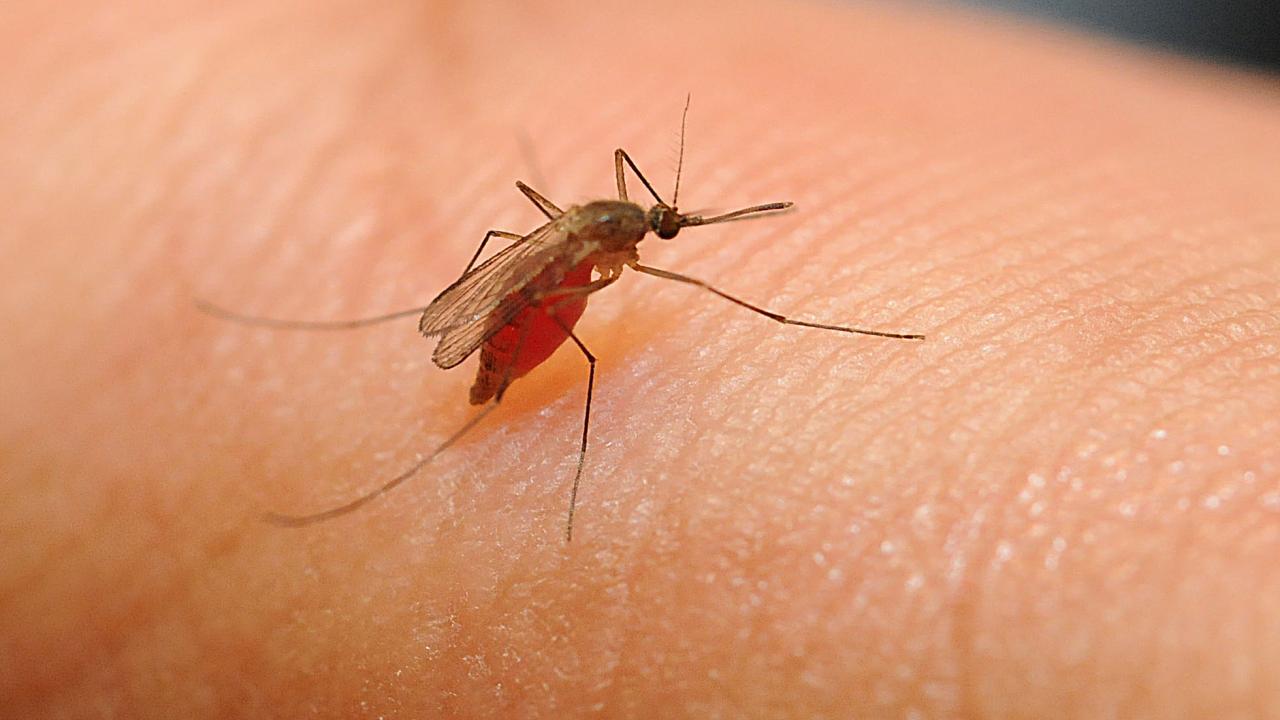
The Emerging St. Louis Encephalitis Virus
Professor Lark Coffey to Present Seminar Jan. 28

Professor Lark Coffey, a virologist in the Department of Pathology, Microbiology and Immunology, UC Davis School of Veterinary Medicine, will speak on "Reemerging St. Louis Encephalitis Virus in the Western United States and Fitness Dynamics in California Culex" at the UC Davis Department of Entomology and Nematology seminar on Wednesday, Jan. 28.
Her seminar begins at 12:10 p.m. in 122 Briggs Hall and also will be on Zoom. The Zoom link: https://ucdavis.zoom.us/j/95882849672.
"The human pathogenic orthoflavivirus St. Louis encephalitis virus (SLEV) reemerged in the western United States in 2015 after more than a decade of apparent absence and has since expanded throughout California with sustained interannual transmission," Coffey says in her abstract. "This shift from the historically sporadic pattern of SLEV activity prior to 2003 raises the question of whether contemporary SLEV strains differ in fitness in Culex vectors compared with earlier strains."
"To determine whether reemerging SLEV possess augmented infectivity and transmissibility that may have facilitated reestablishment, we compared the vector competence of five genotype III SLEV strains detected in California between 2016 and 2023 with a genotype V strain isolated in California in 2003," she said. "We observed that multiple genotype III SLEV strains exhibit equal or greater vector infectivity in Culex quinquefasciatus (but not consistently in Culex tarsalis) than the 2003 genotype V strain, suggesting that enhanced fitness in this vector may contribute to the persistence and geographic spread of SLEV in California since its reemergence in 2015 and underscoring the need for continued vector surveillance and targeted control efforts."
Coffey will be introduced by medical entomologist-geneticist Geoffrey Attardo, associate professor, UC Davis School of Entomology and Nematology.
Arthropod-Borne Virus Ecology and Evolution
Coffey focuses her research on arthropod-borne virus ecology and evolution with a goal of understanding how arboviruses persist via continuous cycling, how they invade new areas, and how they cross-species to cause human and veterinary disease.
She holds a bachelor's degree in biology (2000), cum laude, from the University of the South, Sewanee, Tenn., and a doctorate in experimental pathology and arbovirology (2005) from the University of Texas Medical Branch, Galveston, Texas. She titled her dissertation, "Ecology and Transmission Dynamics of Everglades Virus."
Coffey completed a post-doctoral fellowship in 2006 at UTMB; a senior postdoctoral fellowship in 2011 at the Institut Pasteur, Paris, France, and a senior post-doctoral fellowship in 2013 at the Blood Systems Research Institute, UC San Francisco. She joined the School of Veterinary Medicine as an assistant professor in 2013. She was named a Chancellor's Fellow in 2021, and a Fellow of the American Society of Tropical Medicine and Hygiene in 2022.
Active Research Grants
Her active research grants include:
- Co-Investigator, Innate Immune Responses to SARS-CoV-2 in Alzheimer's Disease Mouse Models, Qizhi Gong (Principal Investigator), National Institutes of Health/ National Institute on Deafness and Other Communication Disorders (NIDCD)
- Co-Investigator, Molecular Mechanisms Linking Viral Replication and Neuropathogenesis, Priya Shah (Principal Investigator), NIH / NIAID (National Institute of Allergy and Infectious Diseases)
- Co-Investigator, Development of a Rhesus Macaque (Macaca mulatta) Model to Test Vaccines and Treatments Against Mayaro virus, a Virus with Epidemic Potential, Shannan Rossi (Principal Investigator), California National Primate Research Center
- Principal Investigator, Evaluating Metagenomic Arbovirus Detection Using Nanopore Sequencing: a Field-Forward Sequencing Approach, (Principal Investigator), Coachella Valley Mosquito and Vector Control District
- Co-Investigator, In Vivo Functional Risk Assessment of Patient-Specific Genetic Variants for Severe COVID-19, Kent Lloyd (Principal Investigator), NIH / Office of the Director
- Co-Investigator, Innate Immune Responses to SARS-CoV-2 Infection in the Mouse Olfactory Epithelium, Qizhi Gong (Principal Investigator), NIH/NIDCD
- Co-Investigator, Impacts of Rapid Landscape Change and Biodiversity on Virus Host Specificity, Christine Kreuder Johnson (Principal Investigator), National Science Foundation/ Ecology and Evolution of Infectious Diseases
- Co-Investigator, Enhancement of Existing ABSL3 Facilities to Accommodate Expanded Mouse Validation and Phenotyping, Kent Lloyd (Principal Investigator), NIH / Office of Research Infrastructure Programs
- Co-Investigator, Assessment of Infectivity, Pathogenesis, and Post-Infection Sequela of COVID-19 (PASC) in Polygenic Humanized Mouse Models of COVID-19, Kent Lloyd (Principal Investigator), NIH / Office of the Director
- Co-Investigator, Dual Anti-Inflammatory and Anti-Viral Strategy to Combat COVID19, Dominik Haudenschild (Principal Investigator), US Department of Defense Congressionally Directed Medical Research Program
- Co-Principal Investigator, EpiCenter for Emerging Infectious Disease Intelligence, Christine Kreuder Johnson, Lark Coffey (Principal Investigator), NIH/NIAID
- Co-Investigator, Efficacy of Bivalent Zika Virus-Yellow Fever Vaccine, Koen Van Rompay (Principal Investigator), Access to Advanced Health Institute (AAHI)